


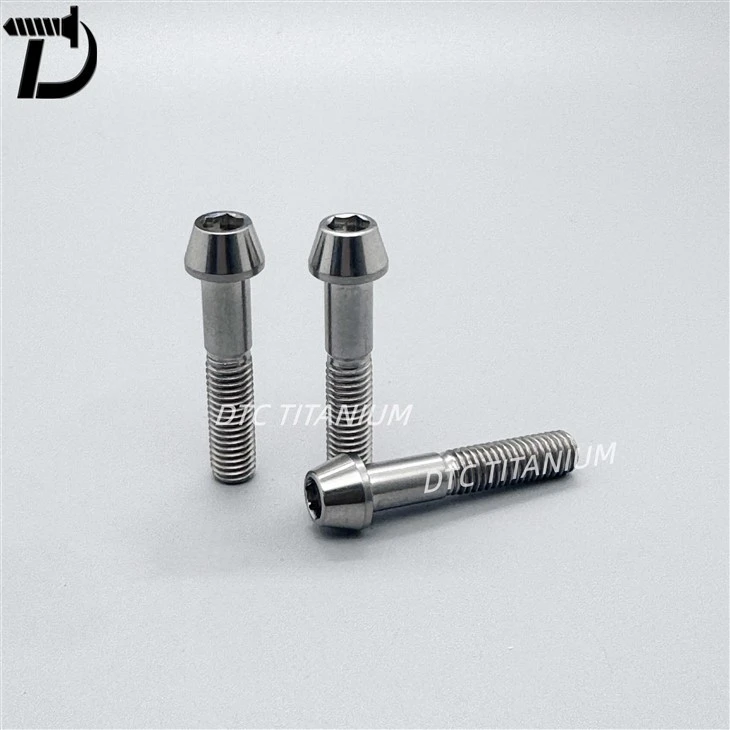
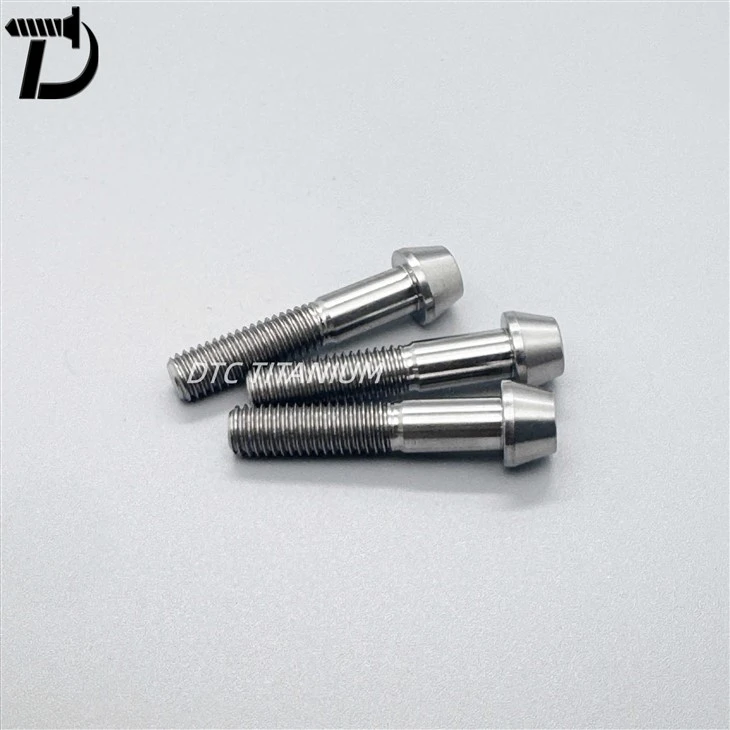
This part-you've probably never taken a close look at it
The titanium caliper pinch bolt refers to the two bolts that secure the caliper to the shock absorber (front brake) or the caliper bracket (rear brake). It's usually hidden by the caliper, so it's easy to overlook when washing the car; it's only removed when replacing brake pads.
However, its condition directly affects whether the brake caliper can remain in the correct position.
What Exactly Does It Do?
The job of the titanium caliper pinch bolt is simple: to securely fasten the caliper to the shock absorber strut or caliper mount, ensuring that the brake pads press evenly against the brake rotor during braking.
This may sound like a simple matter of "just tightening it," but the caliper is subjected to immense shear forces and vibrations generated during braking. If the bolt becomes loose, the caliper will shift, causing uneven pad wear; in severe cases, the caliper may even displace during braking. If the bolt itself lacks sufficient strength, it may even shear and break under the high loads of emergency braking.
Therefore, there are only two core requirements for this bolt: it must be strong enough and stable enough.
Why Switch to Titanium Alloy?

Caliper pinch bolts are considered unsprung mass, and their location is critical.
The caliper pinch bolts are located at the lower end of the shock absorber and move with the wheel. Although the weight difference between a single M10 titanium alloy bolt and a steel one is only about ten grams, a set of four (for a dual-caliper configuration) adds up to only thirty or forty grams. However, the weight-reduction effect of unsprung mass is amplified in terms of driving feel.
Original caliper pinch bolts are typically made of steel, with each weighing around 30–35 grams. Replacing them with Grade 5 titanium alloy reduces the weight of each bolt to around 20 grams. For car owners who have already invested significantly in weight reduction, this is an "easy fix."

Rust Prevention Is More Important Than You Might Think
The biggest practical problem with stock steel caliper pinch bolts is corrosion. The calipers are exposed to road water, car wash water, and brake dust. Once the zinc plating is worn away by a wrench or through natural wear and tear, the exposed steel begins to rust.
What's the problem with rusty bolts? They're impossible to loosen when it's time to remove them. Caliper pinch bolts typically have hex sockets, and once corroded, these sockets can easily become deformed. Combined with the fact that the sockets on stock bolts are already rather shallow, the end result is often this: no matter how hard you try, the bolt head slips, leaving you with no choice but to use a power drill.
Titanium alloy naturally forms an oxide film at room temperature, eliminating the need for plating. It won't rust in environments with moisture, salt, or road grime. You won't have to worry about the bolt and the socket "fusing together" during installation or removal.

Durability-especially for those who frequently remove and reinstall calipers
Changing brake pads on track days, cleaning calipers after off-road riding, modifying brake rotors… Caliper pinch bolts are removed and reinstalled more frequently than most people realize.
After repeated installation and removal, the hex sockets on stock steel bolts are prone to deformation. This is not an isolated issue-on the Suzuki GSX-R forum, owners have reported that the hex sockets on stock caliper bolts are "too large and become unusable after just two or three uses." After switching to Brembo replacement bolts, they found that the latter use an 8mm hex, which is much sturdier than the stock 6mm.
titanium caliper pinch bolts are CNC-machined, ensuring precise head dimensions and a tight fit with tools. Additionally, titanium's lower modulus of elasticity (approximately 110 GPa) results in more uniform elastic deformation under the same torque, allowing the bolts to retain their shape even after repeated removal and installation.
Several Real Issues with OEM Caliper pinch Bolts
The hex socket is too shallow and loose. This is a problem repeatedly mentioned in the GSX-R owner community. The 6mm hex socket on the OEM bolts is not deep enough, resulting in a small contact area for the tool and causing it to slip easily when torque is applied. Some owners have stated outright that "they're ruined after just two or three disassemblies."
Accelerated rusting after the zinc coating wears off. The zinc coating on the caliper bolts wears away first in the head area, where tools repeatedly make contact. Once the zinc coating is damaged and the steel substrate is exposed, rust begins to form in humid environments, spreading inward from the head.
Rust causes the bolt to seize in the aluminum alloy threaded hole. Once a steel bolt has rusted and is screwed into the aluminum alloy shock absorber threaded hole, it becomes extremely difficult to remove. On the Moto Guzzi owners' forum, some users have reported that the original bolts exhibited "mild rust in the fork leg threads," making disassembly difficult.
The strength margin is not as generous as one might think. The strength grade of stainless steel bolts is typically marked on the head; the common A2-70 grade is equivalent to approximately Grade 7, which is lower than the original equipment's high-strength steel bolts rated at Grade 8.8 or 10.9. Grade 5 titanium alloy has a tensile strength of 900–1,100 MPa, far exceeding the 400–600 MPa of ordinary steel; replacing the bolts with titanium actually provides a greater strength margin.
Common Sizes of caliper pinch bolt
The most common size for titanium caliper pinch bolt is M10, but the length and pitch must be carefully verified:
| Specification | Pitch | Common Models/Applications |
| M10×30 | 1.25 | Front calipers on many Japanese and European models |
| M10×35 | 1.5 | Most Harley-Davidson models from 2008 onward M10×40 1.25 mm Kawasaki ZX-7R, ZXR750, etc |
| M10×40 | 1.25 | Kawasaki ZX-7R, ZXR750, etc |
| M10×55/70 | 1.25 | Long bolts used with caliper adapters, such as when upgrading to radial calipers on the Yamaha MT-09 and GSX-R series |
Notice:
- M10 bolts come in two pitch sizes-1.25mm and 1.5mm. The vast majority of brake caliper bolts on Japanese and European motorcycles use 1.25mm (fine-thread), while the standard M10 pitch is 1.5mm.
- Torque values for caliper bolts vary widely: the front calipers on the Suzuki GSX600F/750F require 15–30 N·m, while those on the Harley-Davidson require 38–52 N·m. That's nearly a twofold difference. Do not rely on "it feels about right" when tightening them.
Everything You Need to Know
"I received your package, the caliper pinch bolt looks good"
What should I do if a caliper bolt is rusted solid and won't come out?
If the hex socket in the head hasn't completely stripped, you can first spray it with penetrating oil (such as PB Blaster or WD-40 Specialist), wait about ten minutes, and then try again. If the head is already stripped, you can use a bolt extractor, or drill a small hole in the center of the head with an electric drill and then use a reverse tap. If all else fails, you'll have to drill off the bolt head. After removing the caliper, use pipe wrenches or weld on a nut to extract the remaining threads. Prevention is always easier than cure-apply anti-seize compound during installation.
Are the rear brake caliper bolts the same size as the front ones?
Not necessarily. On many models, the front and rear caliper bolts have the same specifications (typically around M10×1.25×30), but because the rear brake caliper is mounted differently and experiences forces in a different direction, the bolt length may vary. Check each one separately.
What colors do you offer?
Red, purple, blue-purple, green, and more than ten other colors. We have photos available; please contact our sales team to view actual product photos in a variety of colors
Hot Tags: titanium caliper pinch bolt, China titanium caliper pinch bolt manufacturers, suppliers, factory, pinch bolts, titanium hardware for motorcycle, Titanium Pistons for Motorcycles, Titanium Swingarm Pinch Bolts


